- Solar
- 2.4 kW
- Storage
- 15 kWh
- Output
- 5 kW
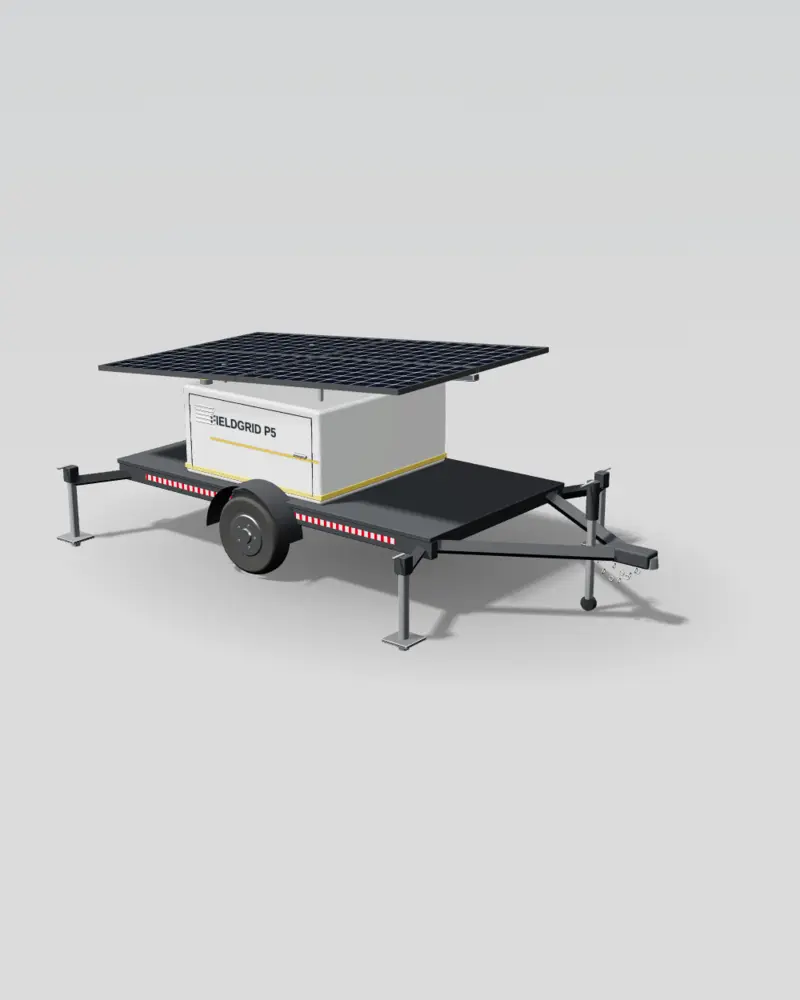
A compact solar generator for a site office, tool charging or a security camera cluster. Fixed array, no setup beyond dropping the jacks.
How solar power works on the Fieldgrid P5
Monocrystalline panels charge a LiFePO4 battery bank through a charge controller. The cameras, lights or outlets run from the battery around the clock. During the day the panels cover the load and refill the battery; at night and through cloudy spells the battery carries everything. The figure that matters is autonomy: how many days the battery can run the load with no useful sun.
A power trailer feeds other equipment, so the load depends on what you plug in. Solar covers daytime loads directly and stores the surplus; the battery size sets how much can run after dark. Measure your loads before choosing, using the Battery and solar sizing calculator.
In its standard build, the Fieldgrid P5 carries a 15.4 kWh LiFePO₄ battery bank and a 2.4 kW fixed, 6 panels array.
When to choose this configuration
Choose solar when the site has a reasonable view of the southern sky, the load is modest, and you want no fuel, no noise and almost no running cost. It is the default for most camera and light trailers in the range.
This is the standard configuration of the Fieldgrid P5, so the specification table on this page describes it directly.
Why people choose the Fieldgrid P5
The P5 is a compact solar generator: a 2.4 kW fixed six-panel array, a 15.4 kWh battery and a 5 kW split-phase inverter with four 5-20R outlets and an L14-30R. There is no setup beyond dropping the jacks, and it can auto-start a backup genset when the battery runs low.
- You need to power a site office, tool charging or a camera cluster
- Night work near homes rules out a running generator
- Setup time must be close to zero
Charging and power supply
There is nothing to refuel. Keep the panels clear: brush off snow, rinse heavy dust and check that nothing new shades the array, such as a stockpile, a parked crane or a site office. Check battery state of charge in the app each morning. If the charge trends downwards over several days, reduce the load (dim lights, lower frame rates) or arrange a generator top-up before the battery reaches its cut-off.
This configuration in numbers
Rule of thumb for this build: the 2.4 kW fixed, 6 panels array would need about 6 hours of full rated output to refill the 15.4 kWh LiFePO₄ bank from empty. On a clear summer day that is achievable over a day or two; on a short December day with low sun, real output is a small fraction of rating, which is why autonomy figures matter more than array size in winter. At 2,800 lb / 1,270 kg dry, the Fieldgrid P5 is a job for a half-ton or three-quarter-ton pickup with a properly rated hitch.
Maintenance
Wipe panels during site visits, check that panel tilt and fasteners are tight after moves, and look for cracked glass. Check cable glands and connectors for chafe. The battery needs no watering, but its management system logs cell health; review it every few months. Keep the battery enclosure locked.
The hitch is a 2 in ball, single axle. Check that the ball on the tow vehicle matches exactly and that the coupler latch is pinned.
Winter operation
Winter is the limiting season. Days are short, the sun is low and snow can cover the panels. Plan around the deep-winter autonomy figure, not the summer one, and see Solar harvest by season and latitude for how latitude changes harvest.
Specifications
| Solar array | 2.4 kW fixed, 6 panels |
|---|---|
| Battery bank | 15.4 kWh LiFePO₄ |
| Inverter | 5 kW continuous, 120/240 V split phase |
| Outlets | 4 × 5-20R, 1 × L14-30R |
| Generator input | Auto start for a backup genset |
| Monitoring | Cellular telemetry, app |
| Hitch | 2 in ball, single axle |
| Dry weight | 2,800 lb / 1,270 kg |
| Power options | Solar, methanol fuel cell, 120 V shore power or diesel generator |
Specifications describe the standard solar build. Mast, cameras, battery and uplink can be changed on a custom build.