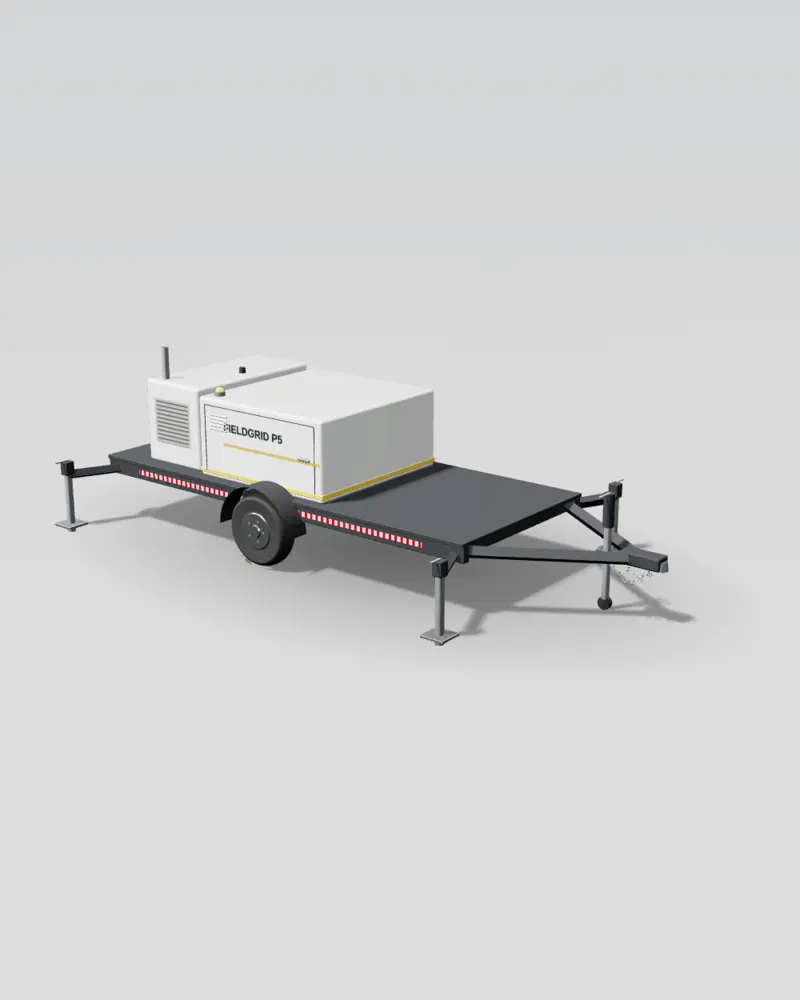
- Solar
- 2.4 kW
- Storage
- 15 kWh
- Output
- 5 kW
A compact solar generator for a site office, tool charging or a security camera cluster. Fixed array, no setup beyond dropping the jacks.
How the diesel generator works on the Fieldgrid P5
An auto-start generator charges the battery only when its state of charge drops to a set point, then shuts down when the battery is full. Most of the time the unit runs silently from the battery, and on solar-equipped trailers the panels still do most of the work in good weather. The generator is insurance for long dark spells and heavy loads.
A generator turns a power trailer into a full hybrid station. The battery and solar handle light loads quietly, and the generator starts for heavy loads or low charge, which keeps run hours far below a genset running all day.
In its standard build, the Fieldgrid P5 carries a 15.4 kWh LiFePO₄ battery bank and a 2.4 kW fixed, 6 panels array.
When to choose this configuration
Choose a diesel generator for heavy loads, sites that run 24 hours a day, and long northern winters where solar harvest is small for months. It is the most robust choice when the unit must never go dark and fuel deliveries are already part of site life.
The standard Fieldgrid P5 ships with solar power. Choosing a diesel generator changes the power system; the mast, sensors and chassis stay the same. The figures below describe the standard build, so ask for autonomy and runtime figures for this configuration.
Why people choose the Fieldgrid P5
The P5 is a compact solar generator: a 2.4 kW fixed six-panel array, a 15.4 kWh battery and a 5 kW split-phase inverter with four 5-20R outlets and an L14-30R. There is no setup beyond dropping the jacks, and it can auto-start a backup genset when the battery runs low.
- You need to power a site office, tool charging or a camera cluster
- Night work near homes rules out a running generator
- Setup time must be close to zero
Refuelling
Refuel with winter-grade diesel in cold months to avoid waxing. The app reports fuel level and generator run time, so refuelling can be scheduled rather than reactive. Fill from approved containers or a fuel truck, use the spill-contained fuel bay and keep absorbent pads on hand. Never fill while the generator is running.
This configuration in numbers
Adding a built-in generator and a fuel tank adds weight to the Fieldgrid P5, and diesel weighs roughly 7 lb per US gallon. Recheck tow vehicle ratings with the loaded weight using the Tow weight checker. At 2,800 lb / 1,270 kg dry, the Fieldgrid P5 is a job for a half-ton or three-quarter-ton pickup with a properly rated hitch.
Maintenance
Service is based on run hours: oil and filter changes, air filter checks and fuel filter changes at the intervals in the generator manual. Check coolant, belts and the battery that starts the engine. Run the generator under load periodically if it has sat idle through a sunny spell, and drain water from the fuel filter.
The hitch is a 2 in ball, single axle. Check that the ball on the tow vehicle matches exactly and that the coupler latch is pinned.
Winter operation
Use winter-blend fuel or an anti-gel additive, check block heater operation if fitted, and keep the exhaust and air intake clear of snow drifts. Auto-start makes diesel the most dependable option through December and January at high latitudes.
Specifications
| Solar array | 2.4 kW fixed, 6 panels |
|---|---|
| Battery bank | 15.4 kWh LiFePO₄ |
| Inverter | 5 kW continuous, 120/240 V split phase |
| Outlets | 4 × 5-20R, 1 × L14-30R |
| Generator input | Auto start for a backup genset |
| Monitoring | Cellular telemetry, app |
| Hitch | 2 in ball, single axle |
| Dry weight | 2,800 lb / 1,270 kg |
| Power options | Solar, methanol fuel cell, 120 V shore power or diesel generator |
Specifications describe the standard solar build. Mast, cameras, battery and uplink can be changed on a custom build.