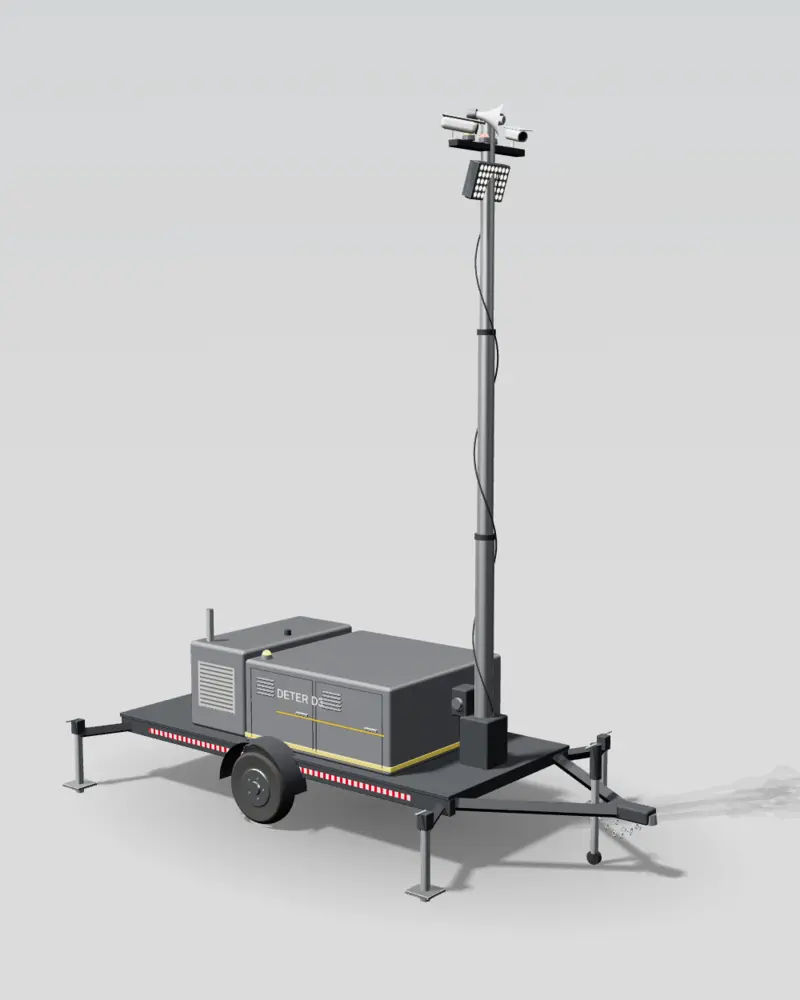
- Audio
- 120 dB
- Strobes
- 3
- Mast
- 20 ft
Built to scare intruders off before they act. Speakers, strobes, a white-light flood and two cameras that trigger them automatically.
How the diesel generator works on the Deter D3
An auto-start generator charges the battery only when its state of charge drops to a set point, then shuts down when the battery is full. Most of the time the unit runs silently from the battery, and on solar-equipped trailers the panels still do most of the work in good weather. The generator is insurance for long dark spells and heavy loads.
On a camera trailer the generator runs rarely, because the load is small. It earns its place in deep winter, or when extra loads such as heaters or flood lights are added, so that the cameras never shut down for lack of charge.
In its standard build, the Deter D3 carries a 10.2 kWh LiFePO₄ battery bank and a 800 W monocrystalline array.
When to choose this configuration
Choose a diesel generator for heavy loads, sites that run 24 hours a day, and long northern winters where solar harvest is small for months. It is the most robust choice when the unit must never go dark and fuel deliveries are already part of site life.
The standard Deter D3 ships with solar power. Choosing a diesel generator changes the power system; the mast, sensors and chassis stay the same. The figures below describe the standard build, so ask for autonomy and runtime figures for this configuration.
Why people choose the Deter D3
The D3 is built to stop intrusions before they happen. Two 4K cameras with AI detection trigger an escalating sequence of 120 dB horn speakers, red, blue and amber strobes and an 18,000 lm white-light flood, and an operator can take over with live talk-down.
- Visible, loud deterrence is the priority
- Repeat intrusions show that recording alone has not worked
- You want automatic warnings without waiting for an operator
Refuelling
Refuel with winter-grade diesel in cold months to avoid waxing. The app reports fuel level and generator run time, so refuelling can be scheduled rather than reactive. Fill from approved containers or a fuel truck, use the spill-contained fuel bay and keep absorbent pads on hand. Never fill while the generator is running.
This configuration in numbers
Adding a built-in generator and a fuel tank adds weight to the Deter D3, and diesel weighs roughly 7 lb per US gallon. Recheck tow vehicle ratings with the loaded weight using the Tow weight checker. At 2,600 lb / 1,179 kg dry, the Deter D3 is a job for a half-ton or three-quarter-ton pickup with a properly rated hitch.
Maintenance
Service is based on run hours: oil and filter changes, air filter checks and fuel filter changes at the intervals in the generator manual. Check coolant, belts and the battery that starts the engine. Run the generator under load periodically if it has sat idle through a sunny spell, and drain water from the fuel filter.
The mast is raised by hand. Inspect the winch cable for fraying and kinks at every move, keep the winch brake working, and never let the mast free-fall when lowering it.
Winter operation
Use winter-blend fuel or an anti-gel additive, check block heater operation if fitted, and keep the exhaust and air intake clear of snow drifts. Auto-start makes diesel the most dependable option through December and January at high latitudes.
Specifications
| Cameras | 2 × 4K fixed with AI detection |
|---|---|
| Audio | 2 × horn speakers, 120 dB, talk-down |
| Lights | Red, blue and amber strobes, 18,000 lm flood |
| Mast height | 20 ft / 6.1 m, manual winch |
| Solar array | 800 W monocrystalline |
| Battery bank | 10.2 kWh LiFePO₄ |
| Connectivity | LTE router |
| Dry weight | 2,600 lb / 1,179 kg |
| Power options | Solar, methanol fuel cell, 120 V shore power or diesel generator |
Specifications describe the standard solar build. Mast, cameras, battery and uplink can be changed on a custom build.