The specialty trailers each do one job that general camera towers do poorly: reading plates, scaring intruders off, or putting a camera in the air.
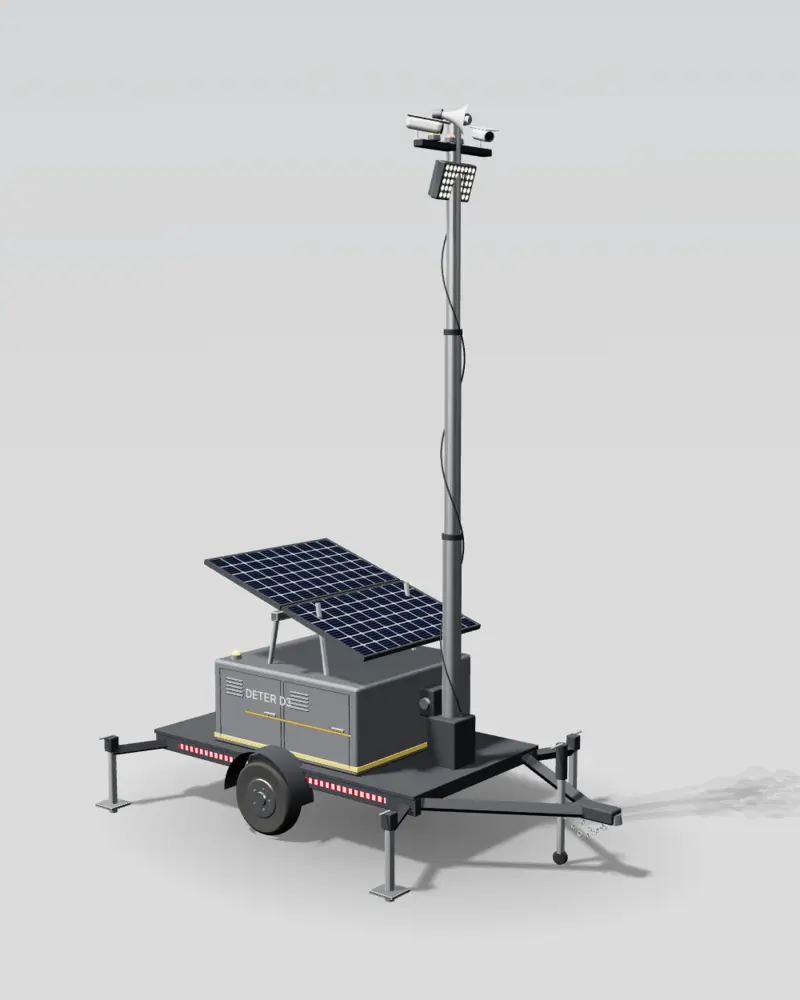
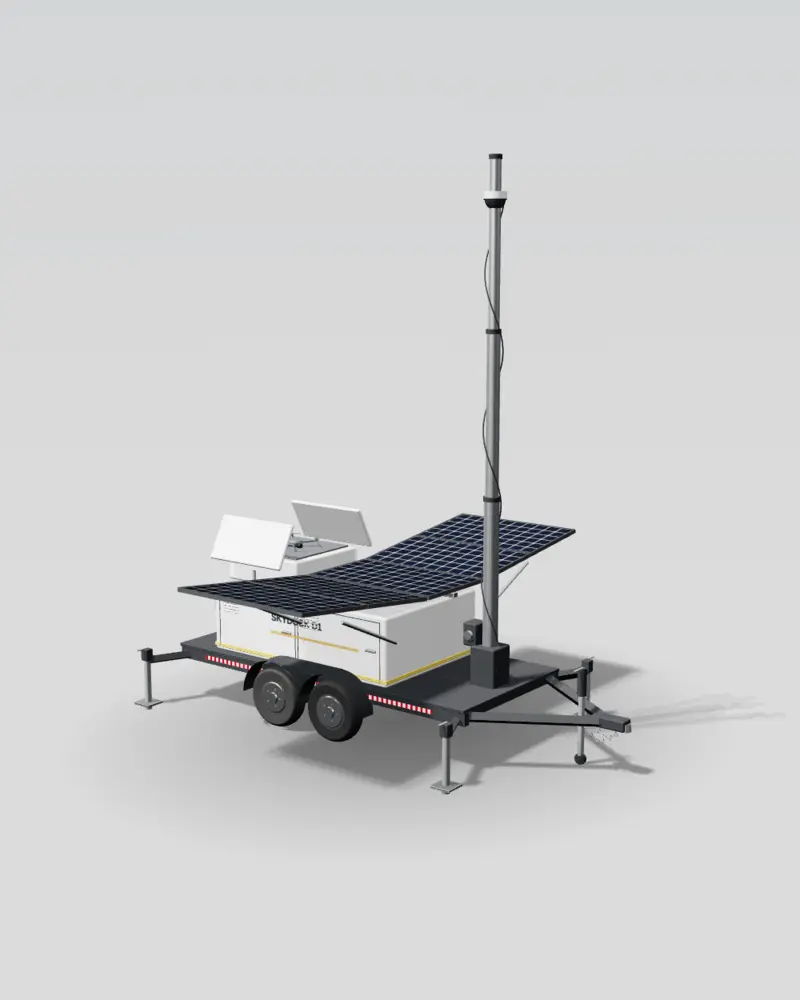
In short
Deter D3: Built to scare intruders off before they act. Speakers, strobes, a white-light flood and two cameras that trigger them automatically.
Skydock D1: A drone dock and camera mast on one trailer. The drone launches on alarm, flies to the event and streams live video back.
Specifications side by side
| Spec | Deter D3 | Skydock D1 |
|---|---|---|
| Cameras | 2 × 4K fixed with AI detection | 1 × PTZ on mast |
| Audio | 2 × horn speakers, 120 dB, talk-down | – |
| Lights | Red, blue and amber strobes, 18,000 lm flood | – |
| Mast height | 20 ft / 6.1 m, manual winch | 20 ft / 6.1 m, electric |
| Solar array | 800 W monocrystalline | 2,000 W fold-out monocrystalline |
| Battery bank | 10.2 kWh LiFePO₄ | 20.5 kWh LiFePO₄ with shore input |
| Connectivity | LTE router | 5G / LTE, satellite |
| Dry weight | 2,600 lb / 1,179 kg | 4,100 lb / 1,860 kg |
| Drone | – | Quadcopter, 4K + thermal, 40 min flight |
| Dock | – | Weatherproof, automatic charging |
| Response | – | Airborne in under 30 s |
| Standard power | Solar with battery | Solar with battery |
Highlighted rows differ. Figures are for the standard build of each model.
Key differences
- The Deter D3 is 1,500 lb lighter dry (2,600 lb / 1,179 kg against 4,100 lb / 1,860 kg), which affects the tow vehicle you need.
- Both use a 20 ft mast, so height is not the deciding factor.
- The Skydock D1 has the larger battery (20.5 kWh LiFePO₄ with shore input), giving more reserve for nights and cloudy spells.
- The Skydock D1 has more solar (2,000 W fold-out monocrystalline), so it refills faster on short winter days.
- Camera package: the Deter D3 has 2 × 4K fixed with AI detection; the Skydock D1 has 1 × PTZ on mast.
- Connectivity: the Deter D3 has LTE router; the Skydock D1 has 5G / LTE, satellite.
Choose the Deter D3 if
- Visible, loud deterrence is the priority
- Repeat intrusions show that recording alone has not worked
- You want automatic warnings without waiting for an operator
Loud sirens near homes can draw complaints, so set schedules and volume with neighbours in mind.
Choose the Skydock D1 if
- The site is too large for fixed cameras to see every corner
- Operators need an aerial view of an alarm before dispatching
- Scheduled patrol flights would replace some guard rounds
Drone operations are regulated. Remote flights usually need approvals, so allow time for them before the deployment date.
Bottom line
Pick the Deter D3 when visible, loud deterrence is the priority. Pick the Skydock D1 when the site is too large for fixed cameras to see every corner. If both seem to fit, let the tow vehicle, the season and the people who will respond to alerts decide. The power source is a separate choice: both are standard with solar power and both are offered on all four power options.