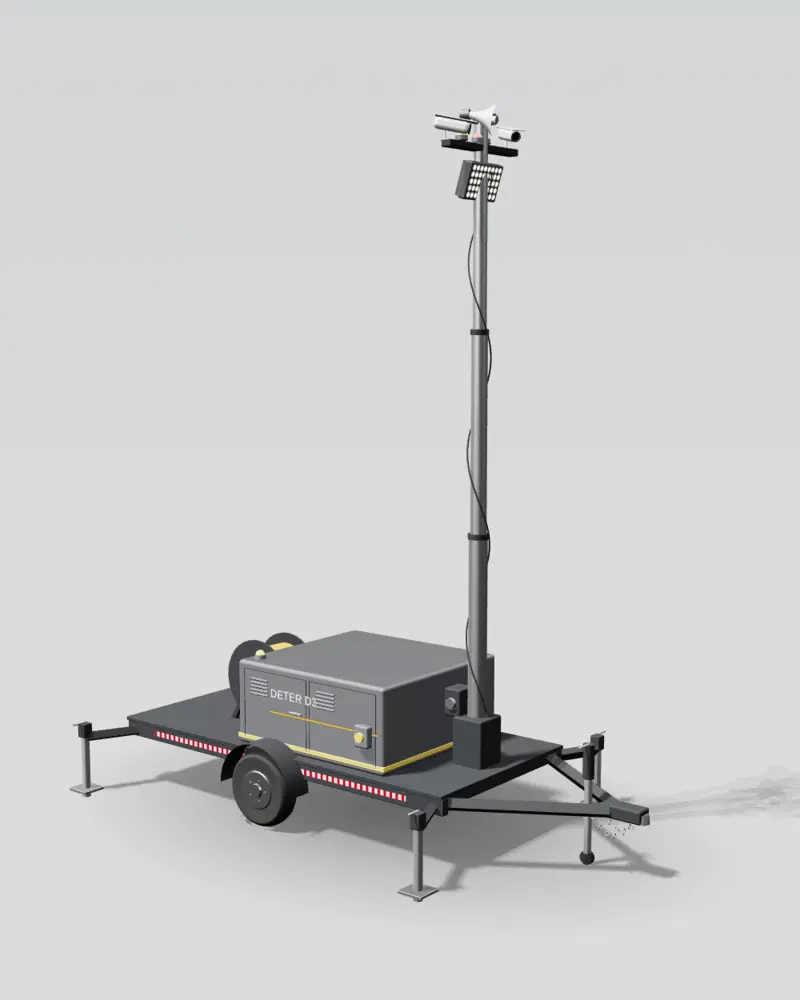
- Audio
- 120 dB
- Strobes
- 3
- Mast
- 20 ft
Built to scare intruders off before they act. Speakers, strobes, a white-light flood and two cameras that trigger them automatically.
How 120 V shore power works on the Deter D3
The trailer plugs into a standard 120 V outlet on site, such as a pole, a building or a temporary power panel. A charger keeps the battery full and the load runs from the battery, so a power cut or a tripped breaker does not stop recording or lighting. The battery acts like a large uninterruptible power supply.
A camera trailer on shore power draws a small, steady current from the outlet. The battery keeps cameras and recorder running through outages, which matters because outages are exactly when some intruders strike.
In its standard build, the Deter D3 carries a 10.2 kWh LiFePO₄ battery bank and a 800 W monocrystalline array.
When to choose this configuration
Choose shore power when the trailer will sit within reach of a reliable outlet for the length of the job: a dealership, a parking structure, a municipal yard or a building under renovation. It removes any dependence on sun or fuel and makes the battery a backup rather than the main source.
The standard Deter D3 ships with solar power. Choosing 120 V shore power changes the power system; the mast, sensors and chassis stay the same. The figures below describe the standard build, so ask for autonomy and runtime figures for this configuration.
Why people choose the Deter D3
The D3 is built to stop intrusions before they happen. Two 4K cameras with AI detection trigger an escalating sequence of 120 dB horn speakers, red, blue and amber strobes and an 18,000 lm white-light flood, and an operator can take over with live talk-down.
- Visible, loud deterrence is the priority
- Repeat intrusions show that recording alone has not worked
- You want automatic warnings without waiting for an operator
Charging and power supply
There is no fuel. Use an outdoor-rated cord of the right gauge for its length, keep the connection off the ground and out of standing water, and plug into a GFCI-protected circuit. Set an alert in the app for loss of input power, so someone knows if the cord is unplugged or a breaker trips; the battery then runs the unit for its normal autonomy.
This configuration in numbers
A standard 120 V, 15 A circuit supplies far more than the Deter D3 draws on average, so after an outage the battery is recharged from the outlet while the unit keeps running. Use a dedicated circuit where possible so other equipment cannot trip it. At 2,600 lb / 1,179 kg dry, the Deter D3 is a job for a half-ton or three-quarter-ton pickup with a properly rated hitch.
Maintenance
Inspect the cord and plug at every visit for cuts, crushed sections and heat damage. Check the inlet on the trailer is dry and its cover closes. Route the cord where vehicles will not drive over it, or protect it with a cable ramp. Test the outage alert occasionally by switching off the supply.
The mast is raised by hand. Inspect the winch cable for fraying and kinks at every move, keep the winch brake working, and never let the mast free-fall when lowering it.
Winter operation
Cold has little effect on a shore-powered unit as long as the supply stays on, and the charger can feed battery heaters. Snow-clearing equipment is the main hazard: mark the cord route clearly and keep it out of plough paths.
Specifications
| Cameras | 2 × 4K fixed with AI detection |
|---|---|
| Audio | 2 × horn speakers, 120 dB, talk-down |
| Lights | Red, blue and amber strobes, 18,000 lm flood |
| Mast height | 20 ft / 6.1 m, manual winch |
| Solar array | 800 W monocrystalline |
| Battery bank | 10.2 kWh LiFePO₄ |
| Connectivity | LTE router |
| Dry weight | 2,600 lb / 1,179 kg |
| Power options | Solar, methanol fuel cell, 120 V shore power or diesel generator |
Specifications describe the standard solar build. Mast, cameras, battery and uplink can be changed on a custom build.