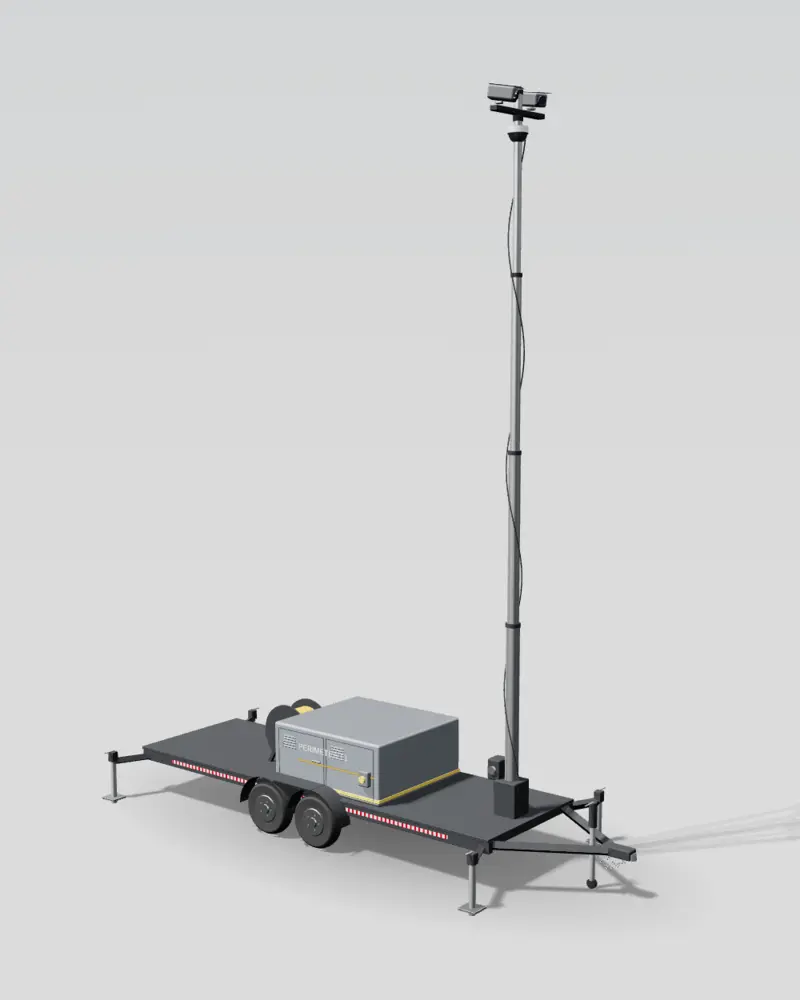
- Mast
- 30 ft
- Thermal
- 640×512
- Range
- 400 m
Two thermal cameras and a PTZ for long fence lines and dark rural sites. Spots people in fog, smoke or total darkness out to 400 m.
How 120 V shore power works on the Perimeter T1
The trailer plugs into a standard 120 V outlet on site, such as a pole, a building or a temporary power panel. A charger keeps the battery full and the load runs from the battery, so a power cut or a tripped breaker does not stop recording or lighting. The battery acts like a large uninterruptible power supply.
A camera trailer on shore power draws a small, steady current from the outlet. The battery keeps cameras and recorder running through outages, which matters because outages are exactly when some intruders strike.
In its standard build, the Perimeter T1 carries a 20.5 kWh LiFePO₄ battery bank and a 1,600 W monocrystalline array.
When to choose this configuration
Choose shore power when the trailer will sit within reach of a reliable outlet for the length of the job: a dealership, a parking structure, a municipal yard or a building under renovation. It removes any dependence on sun or fuel and makes the battery a backup rather than the main source.
The standard Perimeter T1 ships with solar power. Choosing 120 V shore power changes the power system; the mast, sensors and chassis stay the same. The figures below describe the standard build, so ask for autonomy and runtime figures for this configuration.
Why people choose the Perimeter T1
The T1 pairs two 640x512 thermal cameras with a 4K PTZ on a 30 ft pneumatic mast. Thermal detects body heat, so it spots people at up to 400 m in fog, smoke or total darkness, where visible cameras and IR struggle. Fewer units are needed per kilometre of fence, which is why it suits long rural perimeters.
- The perimeter is long, dark and rural
- Fog, dust or smoke regularly blinds visible cameras
- You want to reduce the number of units per kilometre of fence
Charging and power supply
There is no fuel. Use an outdoor-rated cord of the right gauge for its length, keep the connection off the ground and out of standing water, and plug into a GFCI-protected circuit. Set an alert in the app for loss of input power, so someone knows if the cord is unplugged or a breaker trips; the battery then runs the unit for its normal autonomy.
This configuration in numbers
A standard 120 V, 15 A circuit supplies far more than the Perimeter T1 draws on average, so after an outage the battery is recharged from the outlet while the unit keeps running. Use a dedicated circuit where possible so other equipment cannot trip it. At 3,700 lb / 1,678 kg dry, the Perimeter T1 is a job for a half-ton or three-quarter-ton pickup with a properly rated hitch.
Maintenance
Inspect the cord and plug at every visit for cuts, crushed sections and heat damage. Check the inlet on the trailer is dry and its cover closes. Route the cord where vehicles will not drive over it, or protect it with a cable ramp. Test the outage alert occasionally by switching off the supply.
The mast is raised by air. If it slowly creeps down over days, check seals and fittings for leaks. Keep the compressor intake clear and drain moisture as the maker advises, especially before freezing weather.
The hitch is pintle or 2-5/16 in ball, tandem axle. Match the coupler to what your fleet tows with, and check ball size or lunette ring wear before every move.
Winter operation
Cold has little effect on a shore-powered unit as long as the supply stays on, and the charger can feed battery heaters. Snow-clearing equipment is the main hazard: mark the cord route clearly and keep it out of plough paths.
Specifications
| Mast height | 30 ft / 9.1 m, pneumatic |
|---|---|
| Cameras | 2 × thermal 640×512, 1 × 4K PTZ |
| Detection range | Person to 400 m |
| Solar array | 1,600 W monocrystalline |
| Battery bank | 20.5 kWh LiFePO₄ |
| Autonomy | 4 days without sun in deep winter, about 6.5 in mild weather |
| Connectivity | 5G / LTE, satellite failover |
| Recording | On-board NVR, 8 TB |
| Hitch | Pintle or 2-5/16 in ball, tandem axle |
| Dry weight | 3,700 lb / 1,678 kg |
| Power options | Solar, methanol fuel cell, 120 V shore power or diesel generator |
Specifications describe the standard solar build. Mast, cameras, battery and uplink can be changed on a custom build.