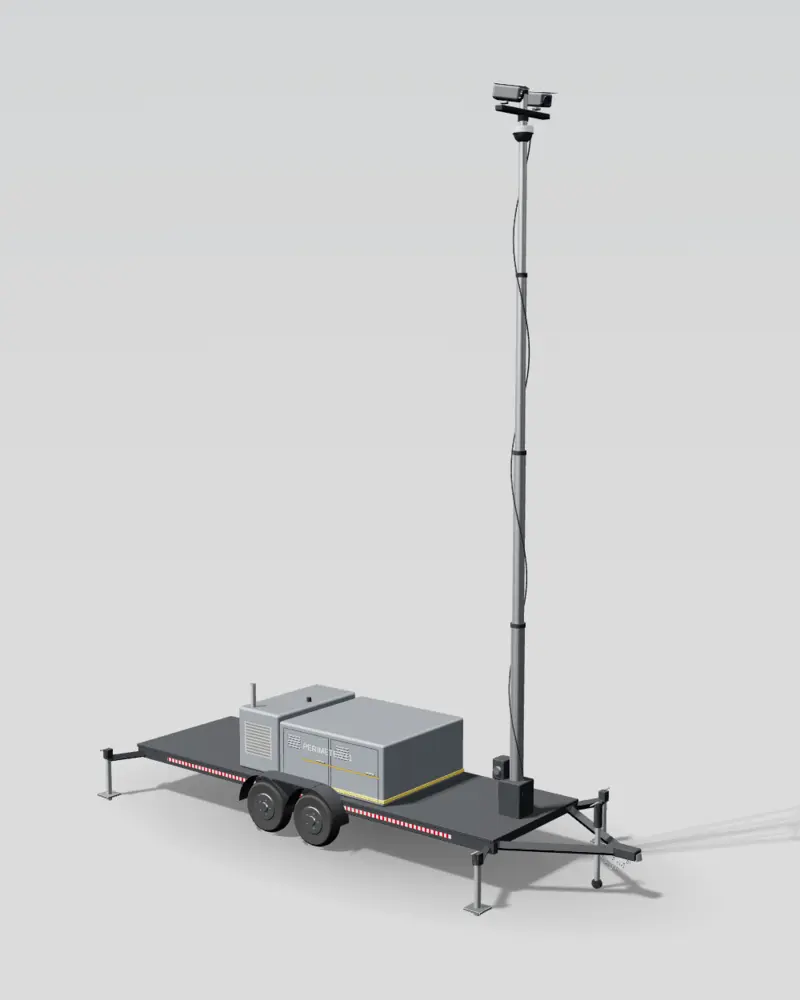
- Mast
- 30 ft
- Thermal
- 640×512
- Range
- 400 m
Two thermal cameras and a PTZ for long fence lines and dark rural sites. Spots people in fog, smoke or total darkness out to 400 m.
How the diesel generator works on the Perimeter T1
An auto-start generator charges the battery only when its state of charge drops to a set point, then shuts down when the battery is full. Most of the time the unit runs silently from the battery, and on solar-equipped trailers the panels still do most of the work in good weather. The generator is insurance for long dark spells and heavy loads.
On a camera trailer the generator runs rarely, because the load is small. It earns its place in deep winter, or when extra loads such as heaters or flood lights are added, so that the cameras never shut down for lack of charge.
In its standard build, the Perimeter T1 carries a 20.5 kWh LiFePO₄ battery bank and a 1,600 W monocrystalline array.
When to choose this configuration
Choose a diesel generator for heavy loads, sites that run 24 hours a day, and long northern winters where solar harvest is small for months. It is the most robust choice when the unit must never go dark and fuel deliveries are already part of site life.
The standard Perimeter T1 ships with solar power. Choosing a diesel generator changes the power system; the mast, sensors and chassis stay the same. The figures below describe the standard build, so ask for autonomy and runtime figures for this configuration.
Why people choose the Perimeter T1
The T1 pairs two 640x512 thermal cameras with a 4K PTZ on a 30 ft pneumatic mast. Thermal detects body heat, so it spots people at up to 400 m in fog, smoke or total darkness, where visible cameras and IR struggle. Fewer units are needed per kilometre of fence, which is why it suits long rural perimeters.
- The perimeter is long, dark and rural
- Fog, dust or smoke regularly blinds visible cameras
- You want to reduce the number of units per kilometre of fence
Refuelling
Refuel with winter-grade diesel in cold months to avoid waxing. The app reports fuel level and generator run time, so refuelling can be scheduled rather than reactive. Fill from approved containers or a fuel truck, use the spill-contained fuel bay and keep absorbent pads on hand. Never fill while the generator is running.
This configuration in numbers
Adding a built-in generator and a fuel tank adds weight to the Perimeter T1, and diesel weighs roughly 7 lb per US gallon. Recheck tow vehicle ratings with the loaded weight using the Tow weight checker. At 3,700 lb / 1,678 kg dry, the Perimeter T1 is a job for a half-ton or three-quarter-ton pickup with a properly rated hitch.
Maintenance
Service is based on run hours: oil and filter changes, air filter checks and fuel filter changes at the intervals in the generator manual. Check coolant, belts and the battery that starts the engine. Run the generator under load periodically if it has sat idle through a sunny spell, and drain water from the fuel filter.
The mast is raised by air. If it slowly creeps down over days, check seals and fittings for leaks. Keep the compressor intake clear and drain moisture as the maker advises, especially before freezing weather.
The hitch is pintle or 2-5/16 in ball, tandem axle. Match the coupler to what your fleet tows with, and check ball size or lunette ring wear before every move.
Winter operation
Use winter-blend fuel or an anti-gel additive, check block heater operation if fitted, and keep the exhaust and air intake clear of snow drifts. Auto-start makes diesel the most dependable option through December and January at high latitudes.
Specifications
| Mast height | 30 ft / 9.1 m, pneumatic |
|---|---|
| Cameras | 2 × thermal 640×512, 1 × 4K PTZ |
| Detection range | Person to 400 m |
| Solar array | 1,600 W monocrystalline |
| Battery bank | 20.5 kWh LiFePO₄ |
| Autonomy | 4 days without sun in deep winter, about 6.5 in mild weather |
| Connectivity | 5G / LTE, satellite failover |
| Recording | On-board NVR, 8 TB |
| Hitch | Pintle or 2-5/16 in ball, tandem axle |
| Dry weight | 3,700 lb / 1,678 kg |
| Power options | Solar, methanol fuel cell, 120 V shore power or diesel generator |
Specifications describe the standard solar build. Mast, cameras, battery and uplink can be changed on a custom build.