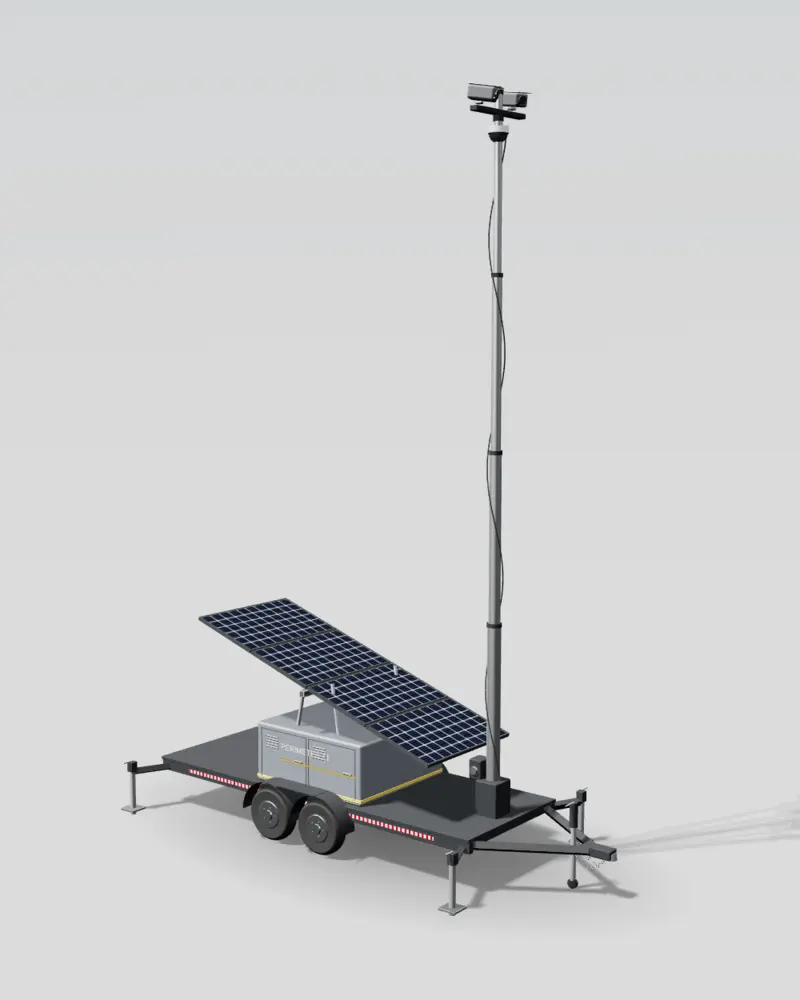
- Mast
- 30 ft
- Thermal
- 640×512
- Range
- 400 m
Two thermal cameras and a PTZ for long fence lines and dark rural sites. Spots people in fog, smoke or total darkness out to 400 m.
How solar power works on the Perimeter T1
Monocrystalline panels charge a LiFePO4 battery bank through a charge controller. The cameras, lights or outlets run from the battery around the clock. During the day the panels cover the load and refill the battery; at night and through cloudy spells the battery carries everything. The figure that matters is autonomy: how many days the battery can run the load with no useful sun.
A camera trailer is a small, steady load: cameras, recorder and router draw power around the clock, with short peaks when a PTZ moves or a strobe fires. That even demand is a good match for solar, and it is why the catalogue quotes autonomy in days without sun.
In its standard build, the Perimeter T1 carries a 20.5 kWh LiFePO₄ battery bank and a 1,600 W monocrystalline array. For the standard build the catalogue quotes: 4 days without sun in deep winter, about 6.5 in mild weather.
When to choose this configuration
Choose solar when the site has a reasonable view of the southern sky, the load is modest, and you want no fuel, no noise and almost no running cost. It is the default for most camera and light trailers in the range.
This is the standard configuration of the Perimeter T1, so the specification table on this page describes it directly.
Why people choose the Perimeter T1
The T1 pairs two 640x512 thermal cameras with a 4K PTZ on a 30 ft pneumatic mast. Thermal detects body heat, so it spots people at up to 400 m in fog, smoke or total darkness, where visible cameras and IR struggle. Fewer units are needed per kilometre of fence, which is why it suits long rural perimeters.
- The perimeter is long, dark and rural
- Fog, dust or smoke regularly blinds visible cameras
- You want to reduce the number of units per kilometre of fence
Charging and power supply
There is nothing to refuel. Keep the panels clear: brush off snow, rinse heavy dust and check that nothing new shades the array, such as a stockpile, a parked crane or a site office. Check battery state of charge in the app each morning. If the charge trends downwards over several days, reduce the load (dim lights, lower frame rates) or arrange a generator top-up before the battery reaches its cut-off.
This configuration in numbers
Rule of thumb for this build: the 1,600 W monocrystalline array would need about 13 hours of full rated output to refill the 20.5 kWh LiFePO₄ bank from empty. On a clear summer day that is achievable over a day or two; on a short December day with low sun, real output is a small fraction of rating, which is why autonomy figures matter more than array size in winter. At 3,700 lb / 1,678 kg dry, the Perimeter T1 is a job for a half-ton or three-quarter-ton pickup with a properly rated hitch.
Maintenance
Wipe panels during site visits, check that panel tilt and fasteners are tight after moves, and look for cracked glass. Check cable glands and connectors for chafe. The battery needs no watering, but its management system logs cell health; review it every few months. Keep the battery enclosure locked.
The mast is raised by air. If it slowly creeps down over days, check seals and fittings for leaks. Keep the compressor intake clear and drain moisture as the maker advises, especially before freezing weather.
The hitch is pintle or 2-5/16 in ball, tandem axle. Match the coupler to what your fleet tows with, and check ball size or lunette ring wear before every move.
Winter operation
Winter is the limiting season. Days are short, the sun is low and snow can cover the panels. Plan around the deep-winter autonomy figure, not the summer one, and see Solar harvest by season and latitude for how latitude changes harvest.
Specifications
| Mast height | 30 ft / 9.1 m, pneumatic |
|---|---|
| Cameras | 2 × thermal 640×512, 1 × 4K PTZ |
| Detection range | Person to 400 m |
| Solar array | 1,600 W monocrystalline |
| Battery bank | 20.5 kWh LiFePO₄ |
| Autonomy | 4 days without sun in deep winter, about 6.5 in mild weather |
| Connectivity | 5G / LTE, satellite failover |
| Recording | On-board NVR, 8 TB |
| Hitch | Pintle or 2-5/16 in ball, tandem axle |
| Dry weight | 3,700 lb / 1,678 kg |
| Power options | Solar, methanol fuel cell, 120 V shore power or diesel generator |
Specifications describe the standard solar build. Mast, cameras, battery and uplink can be changed on a custom build.