The communications trailers solve different network problems: moving data around a site, bringing data to a site, or getting a site online quickly.
In short
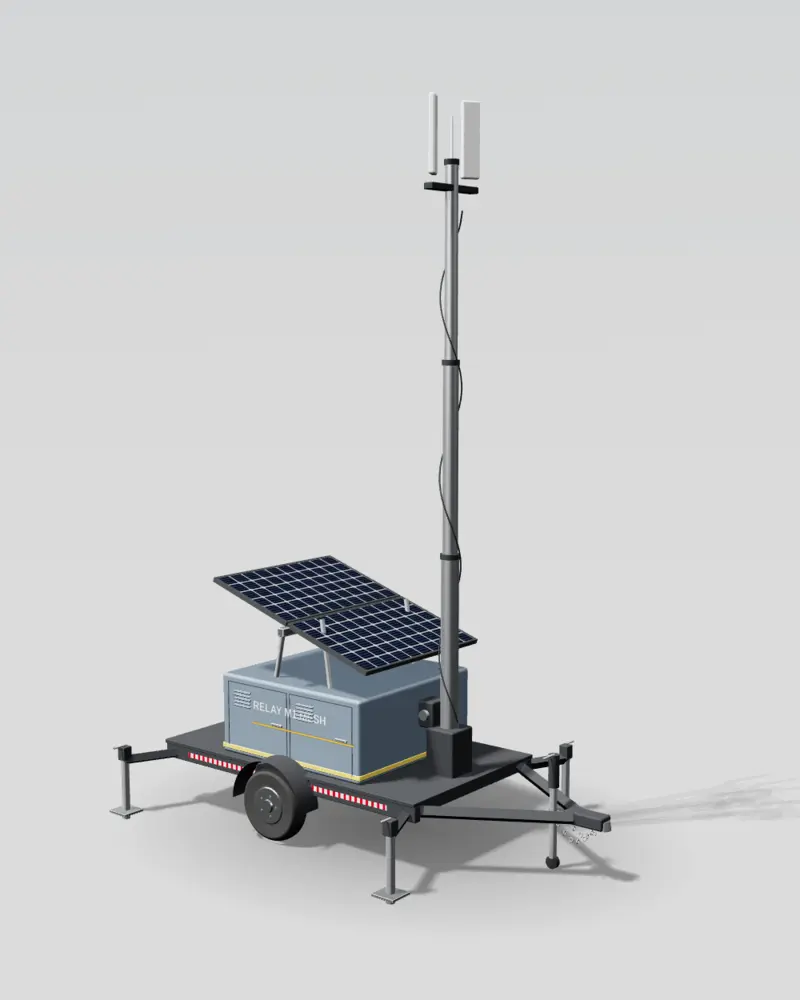
Relay M1 Mesh: A small solar trailer that links camera towers over a private wireless mesh, so one internet connection serves the whole site.
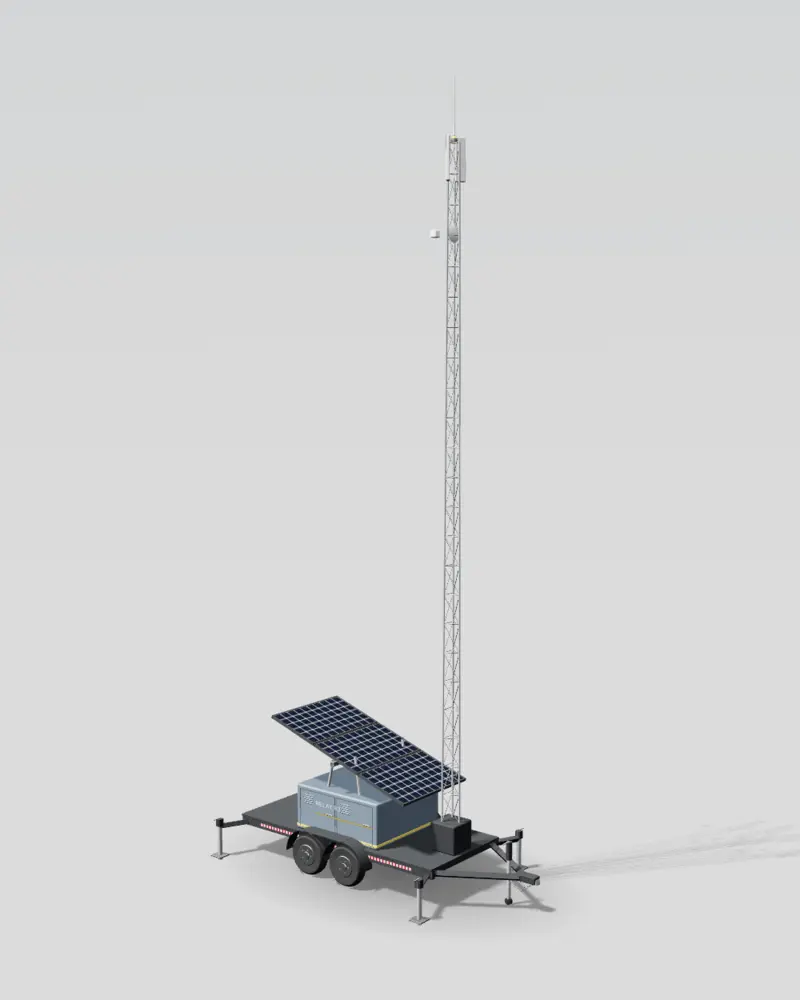
Relay R3: Brings data to sites without it. A 40 ft lattice mast with cellular boosters, satellite internet and mesh radios for nearby units.
Specifications side by side
| Spec | Relay M1 Mesh | Relay R3 |
|---|---|---|
| Mast height | 20 ft / 6.1 m, manual | 40 ft / 12.2 m, lattice, winch |
| Radios | 2 × 5 GHz sector, 1 × point-to-point | – |
| Range | Up to 2 km per link | – |
| Solar array | 800 W monocrystalline | 1,200 W monocrystalline |
| Battery bank | 10.2 kWh LiFePO₄ | 15.4 kWh LiFePO₄ |
| Autonomy | 3 days without sun in deep winter | 3 days without sun in deep winter |
| Hitch | 2 in ball, single axle | 2-5/16 in ball, tandem axle |
| Dry weight | 2,200 lb / 998 kg | 3,600 lb / 1,633 kg |
| Uplink | – | 5G / LTE with booster, satellite internet |
| Local network | – | Wi-Fi 6, 2 km point-to-multipoint mesh |
| Rack space | – | 6U weatherproof equipment bay |
| Standard power | Solar with battery | Solar with battery |
Highlighted rows differ. Figures are for the standard build of each model.
Key differences
- The Relay M1 Mesh is 1,400 lb lighter dry (2,200 lb / 998 kg against 3,600 lb / 1,633 kg), which affects the tow vehicle you need.
- The Relay R3 raises its antennas higher (40 ft / 12.2 m, lattice, winch), which widens the view and clears more obstacles but increases wind load.
- The Relay R3 has the larger battery (15.4 kWh LiFePO₄), giving more reserve for nights and cloudy spells.
- The Relay R3 has more solar (1,200 W monocrystalline), so it refills faster on short winter days.
- Only the Relay R3 lists uplink: 5G / LTE with booster, satellite internet.
- Hitch: 2 in ball, single axle on the Relay M1 Mesh, 2-5/16 in ball, tandem axle on the Relay R3.
Choose the Relay M1 Mesh if
- Several towers share one site and only one spot has good signal
- Buildings or terrain block line of sight between units
- You want to cut the number of cellular data plans
It moves data around the site but provides no internet itself. Pair it with an uplink from a camera tower, an R3 or an S2 Satellite.
Choose the Relay R3 if
- The site has weak cellular coverage at ground level
- You need to mount your own radios or network gear
- Emergency or remote-camp deployments need internet for crews
If cellular coverage is already good, a camera tower's own router may be enough and the M1 can extend it.
Bottom line
Pick the Relay M1 Mesh when several towers share one site and only one spot has good signal. Pick the Relay R3 when the site has weak cellular coverage at ground level. If both seem to fit, let the tow vehicle, the season and the people who will respond to alerts decide. The power source is a separate choice: both are standard with solar power and both are offered on all four power options.