The communications trailers solve different network problems: moving data around a site, bringing data to a site, or getting a site online quickly.
In short
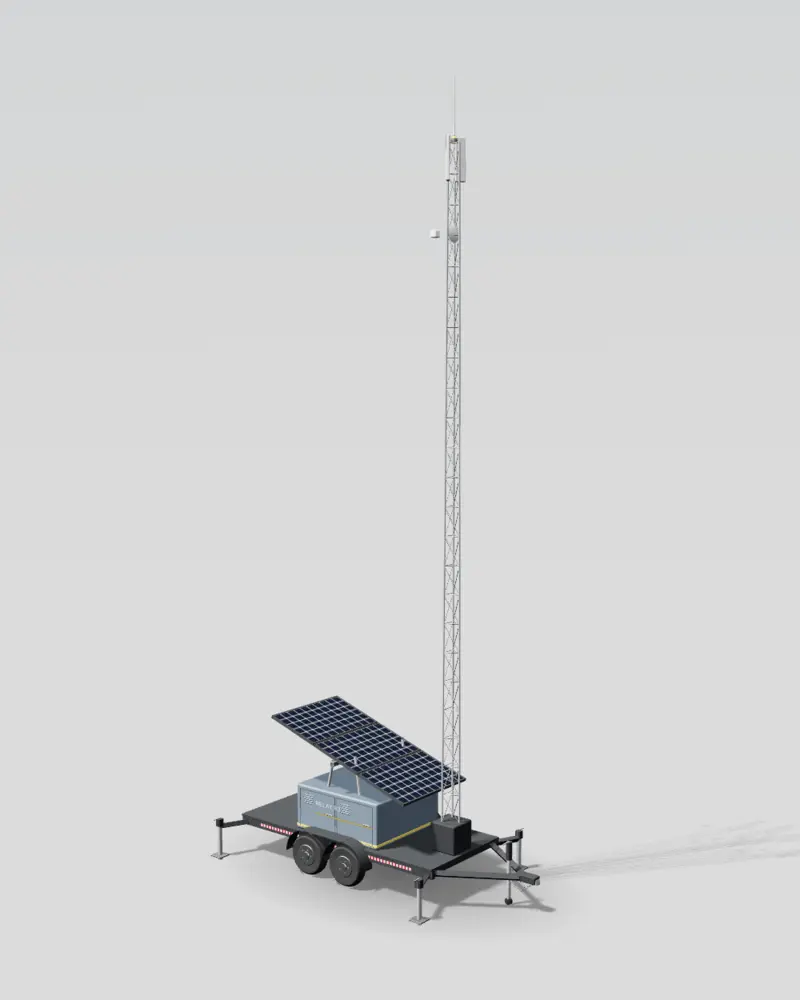
Relay R3: Brings data to sites without it. A 40 ft lattice mast with cellular boosters, satellite internet and mesh radios for nearby units.
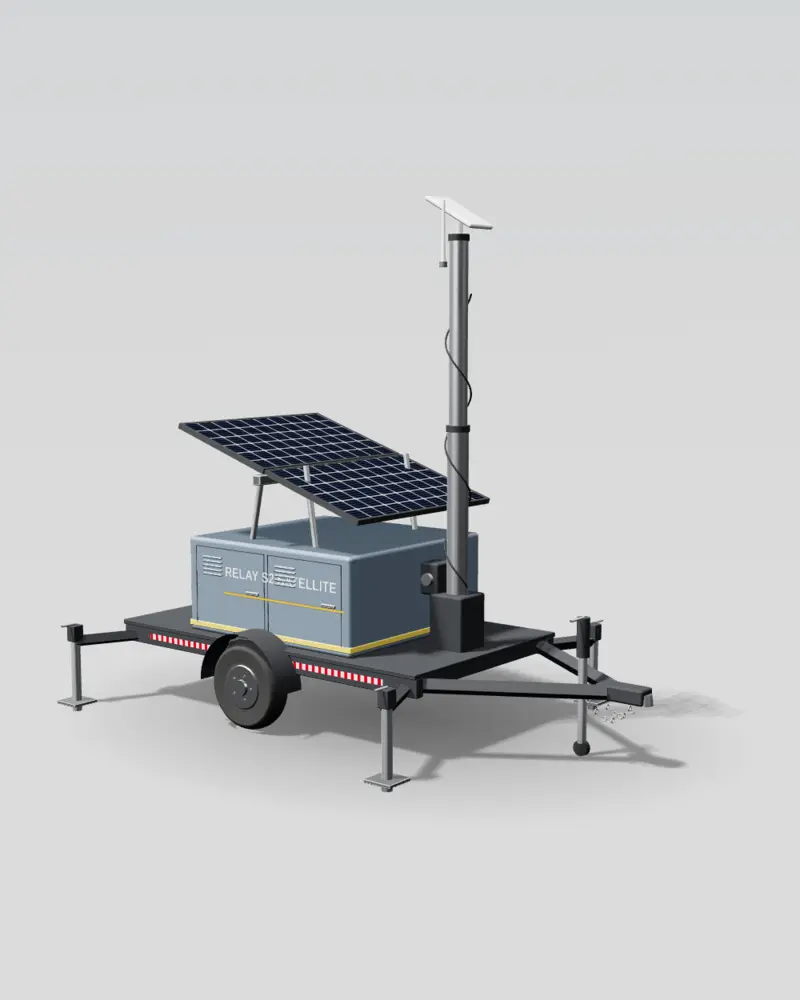
Relay S2 Satellite: A low-profile trailer with a satellite terminal, LTE backup and a Wi-Fi hotspot. Internet anywhere with a view of the sky, in about ten minutes.
Specifications side by side
| Spec | Relay R3 | Relay S2 Satellite |
|---|---|---|
| Mast height | 40 ft / 12.2 m, lattice, winch | 12 ft / 3.7 m, manual |
| Uplink | 5G / LTE with booster, satellite internet | Low-earth-orbit satellite, LTE failover |
| Local network | Wi-Fi 6, 2 km point-to-multipoint mesh | Wi-Fi 6 hotspot, 300 m |
| Solar array | 1,200 W monocrystalline | 800 W monocrystalline |
| Battery bank | 15.4 kWh LiFePO₄ | 10.2 kWh LiFePO₄ |
| Autonomy | 3 days without sun in deep winter | 2.5 days without sun in deep winter |
| Rack space | 6U weatherproof equipment bay | – |
| Hitch | 2-5/16 in ball, tandem axle | 2 in ball, single axle |
| Dry weight | 3,600 lb / 1,633 kg | 2,350 lb / 1,066 kg |
| Standard power | Solar with battery | Solar with battery |
Highlighted rows differ. Figures are for the standard build of each model.
Key differences
- The Relay S2 Satellite is 1,250 lb lighter dry (2,350 lb / 1,066 kg against 3,600 lb / 1,633 kg), which affects the tow vehicle you need.
- The Relay R3 raises its antennas higher (40 ft / 12.2 m, lattice, winch), which widens the view and clears more obstacles but increases wind load.
- The Relay R3 has the larger battery (15.4 kWh LiFePO₄), giving more reserve for nights and cloudy spells.
- The Relay R3 has more solar (1,200 W monocrystalline), so it refills faster on short winter days.
- Uplink: the Relay R3 has 5G / LTE with booster, satellite internet; the Relay S2 Satellite has Low-earth-orbit satellite, LTE failover.
- Hitch: 2-5/16 in ball, tandem axle on the Relay R3, 2 in ball, single axle on the Relay S2 Satellite.
Choose the Relay R3 if
- The site has weak cellular coverage at ground level
- You need to mount your own radios or network gear
- Emergency or remote-camp deployments need internet for crews
If cellular coverage is already good, a camera tower's own router may be enough and the M1 can extend it.
Choose the Relay S2 Satellite if
- You need internet quickly where none exists
- Crews, cameras and a site office all need one connection
- Short rentals by the week suit the job
It needs a clear view of the sky, so tall trees, buildings or cliffs to the north or south can interrupt service.
Bottom line
Pick the Relay R3 when the site has weak cellular coverage at ground level. Pick the Relay S2 Satellite when you need internet quickly where none exists. If both seem to fit, let the tow vehicle, the season and the people who will respond to alerts decide. The power source is a separate choice: both are standard with solar power and both are offered on all four power options.