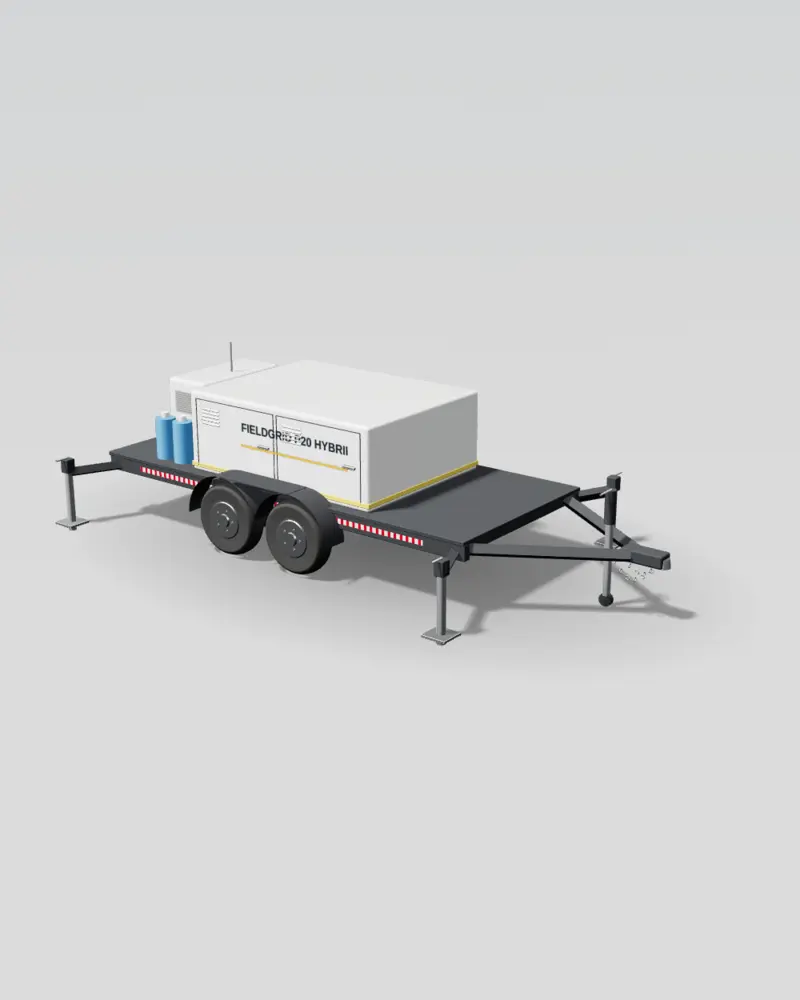
- Solar
- 7.2 kW
- Storage
- 60 kWh
- Output
- 20 kW
Solar wings, a 60 kWh battery and an integrated generator. Power for remote camps, pump stations and multi-unit security deployments.
How the methanol fuel cell works on the Fieldgrid P20 Hybrid
A methanol fuel cell converts methanol and air into electricity, with water vapour and carbon dioxide as by-products. It does not run the load directly. Instead it starts automatically when the battery falls to a set level, tops the battery back up, and stops. The solar array, where fitted, still contributes, so the fuel cell fills only the gap the sun cannot cover.
On a power trailer a fuel cell adds a steady trickle of charge around the clock. It suits small, continuous loads such as cameras, routers or sensors fed from the trailer, but not heavy tools; for large loads a generator is the better backup.
In its standard build, the Fieldgrid P20 Hybrid carries a 61 kWh LiFePO₄ battery bank and a 7.2 kW fold-out, 18 panels array. The standard build also has a 20 kW diesel, auto start generator.
When to choose this configuration
Choose methanol for long winter deployments, shaded sites or locations where a diesel generator's noise, exhaust or refuelling schedule would be a problem. Fuel cells are quiet and clean enough to sit near offices and homes, and a cartridge lasts weeks rather than days on a typical camera load.
The standard Fieldgrid P20 Hybrid ships with a diesel generator. Choosing a methanol fuel cell changes the power system; the mast, sensors and chassis stay the same. The figures below describe the standard build, so ask for autonomy and runtime figures for this configuration.
Why people choose the Fieldgrid P20 Hybrid
The P20 Hybrid combines a 7.2 kW fold-out array, a 61 kWh battery, a 20 kW inverter in split-phase or three-phase and a 20 kW auto-start diesel generator. Cam-lock outputs feed site distribution. The catalogue quotes up to 85% fewer generator run hours, and it can power several camera and light towers.
- A remote camp, pump station or multi-unit deployment needs a power hub
- You need three-phase 120/208 V or cam-lock distribution
- Generator run hours and fuel cost need to come down
Refuelling
Refuelling means swapping a sealed methanol cartridge, which takes a few minutes and needs no pumps or funnels. The app reports fill level, so a replacement can be brought on a scheduled visit. Store spare cartridges upright in a ventilated, locked space away from ignition sources, and follow the safety data sheet: methanol is flammable and toxic if swallowed.
This configuration in numbers
With a large 61 kWh LiFePO₄ bank, the fuel cell acts as a slow, steady top-up. Check with the sales team whether one fuel cell keeps pace with this model's load at your latitude, or whether a generator suits better. At 9,400 lb / 4,264 kg dry, the Fieldgrid P20 Hybrid is heavy-equipment towing that needs a heavy-duty truck and a rated pintle hook.
Maintenance
Fuel cells have few moving parts. Keep the air intake and exhaust clear of snow and debris, check hoses and fittings for leaks at every cartridge change, and follow the maker's service interval for filters. Record run hours from the app so service can be planned.
The Fieldgrid P20 Hybrid uses a pintle hitch (pintle, tandem axle). Check the lunette ring for wear and close and pin the pintle latch before every move.
Winter operation
Fuel cells give off heat while running and many units run a frost-protection cycle in deep cold. Keep spare cartridges from freezing solid by storing them indoors, and keep the vent free of drifting snow. Methanol is the strongest option for sites where solar collapses in December and a generator is not welcome.
Specifications
| Solar array | 7.2 kW fold-out, 18 panels |
|---|---|
| Battery bank | 61 kWh LiFePO₄ |
| Inverter | 20 kW continuous, 120/240 V or 120/208 V 3-phase |
| Generator | 20 kW diesel, auto start |
| Outlets | Cam-lock panel plus receptacles |
| Monitoring | Cellular telemetry, app |
| Hitch | Pintle, tandem axle |
| Dry weight | 9,400 lb / 4,264 kg |
| Power options | Solar, methanol fuel cell, 120 V shore power or diesel generator |
Specifications describe the standard diesel generator build. Mast, cameras, battery and uplink can be changed on a custom build.